
Water almost never enters where the stain appears. It gets in above the opening — through failed head flashing, a missing kickout, or the siding and trim higher up the wall — then runs down the framing and shows itself at the casing or sill. That’s why fixing the stain fixes nothing. US ProPaint & Renovation finds the entry point first, then repairs the damage, dries the structure, and refinishes it.
By JR Reis, Owner & President · Last updated October 2026
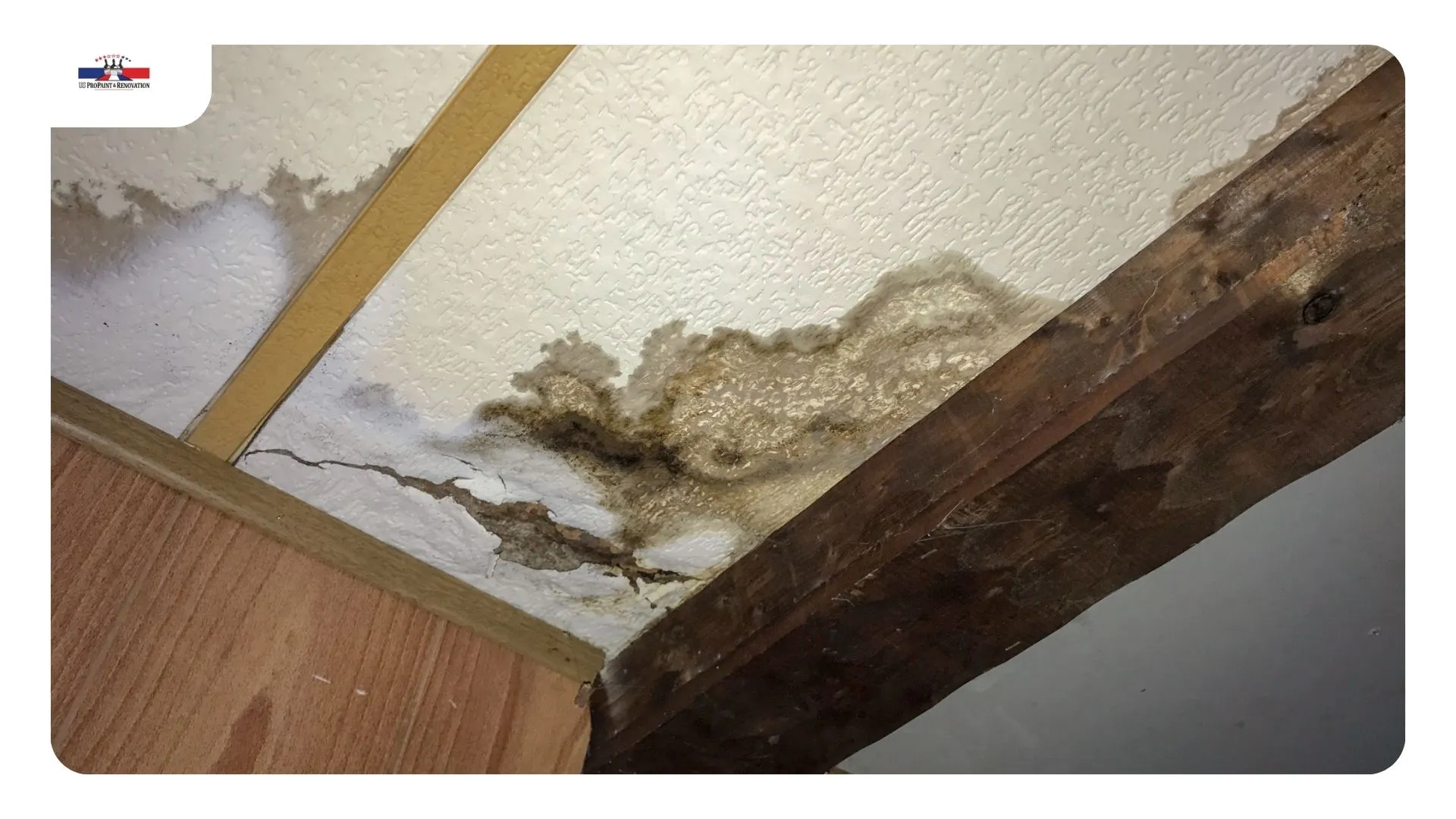
Six causes account for nearly everything we find in Weymouth homes.
Failed or missing head flashing. The metal or membrane above the window that directs water out over the siding. When it’s absent, corroded, or was never lapped correctly behind the building paper, every rain puts water straight into the wall. This is the most common cause and the least visible — you cannot see it without opening something up.
A missing kickout flashing. Where a roof edge meets a sidewall above a window, a small diverter is supposed to kick runoff out into the gutter. When it’s missing, an entire roof plane’s worth of water runs down inside the wall. It’s a two-dollar part responsible for thousands in damage, and it’s omitted constantly.
No sill pan, or a sill pitched the wrong way. Water that gets past the glass or sash should drain out. Without a pan under the unit, it drains into the rough opening instead.
Failed perimeter sealant. Caulk has a service life. When it cracks or pulls away at the casing and trim joints, it stops shedding and starts holding water against wood.
Siding, trim, or gutters above the opening. Overflowing gutters, a rotted trim board, a bad siding joint — all of them deliver water to the window, which then gets blamed for it.
Wind-driven rain. On exposed elevations near the Back River, Hingham Bay, and out toward Wessagusset, rain arrives sideways. Assemblies that shed a vertical rain perfectly well will leak under horizontal pressure, and it only shows up in certain storms from certain directions.
One thing that is not a leak: water on the inside face of the glass in cold weather, worst in the morning, better by afternoon. That’s condensation — warm indoor humidity meeting cold glass. It needs ventilation and humidity control, not flashing work. Fogging between the panes is different again: that’s a failed insulated glass seal, and it’s covered in our Weymouth window replacement guide.
The interior stain tells you where water exits. It says almost nothing about where it came in. So we work from the top of the wall down, not outward from the damage.
The failure mode we’re avoiding is the common one: caulk the perimeter, repaint the casing, call it done. It looks fixed for a season. The water keeps coming, and now it’s behind fresh paint.
Usually, yes — and this is where a lot of homeowners get sold more than they need.
Repairable without replacing the window:
The window has to go when:
That’s the dividing line, and it’s worth being precise about: trim, casing, sill, and plaster are repairs. A rotted frame is a replacement. If the frame itself is gone, the full-frame replacement path and what it costs are in our window installation guide for Weymouth — full-frame is specifically the method that lets the opening be re-flashed properly, which is often the real fix.

This is where being a painting and carpentry company rather than a restoration franchise changes the result.
Carpentry first. Rotted sill, casing, stool, and apron come out and get replaced in kind, matched to the existing profile. On older Weymouth houses the trim profiles aren’t stock — they get matched rather than substituted with whatever the lumberyard has.
New wood gets primed on all sides. Back, edges, and ends, before it goes in. Trim primed only on the face takes up moisture from behind and pushes the finish off within a few seasons.
Plaster gets treated as plaster. In a house with plaster over wood lath, the lath itself holds water. Damp plaster that’s still bonded can be dried and skimmed; plaster that has lost its keys behind the lath has to come out. Those are different jobs and they get decided after the wall is dry, not before.
Then paint. The same crew that did the carpentry finishes it, which is why the repair blends into the wall instead of announcing itself as a patch. Stains get a stain-blocking primer — water staining bleeds through ordinary primer and comes back months later.
For the exterior side of this, where the question is whether siding should be repaired, repainted, or replaced, see our siding guide.
Closing up a wet wall is the most expensive shortcut in this trade.
We dry before we rebuild. Extraction, demolition of unsalvageable material, and controlled drying are part of what we do — not a separate contractor you have to find first. Drying is confirmed with meter readings, not by whether it looks dry. Wood and plaster that feel dry on the surface routinely aren’t.
Mold timing is why speed matters. On wet cellulose — framing, lath, plaster, paper-faced drywall — mold can establish within roughly 24 to 48 hours. A leak discovered on a Friday and looked at the following week is a different job from one addressed immediately.
We’re licensed for the mold side. Certified Residential Mold Inspector (CRMI0000036883) and Certified Mold Remediator (CMR0000036885). If we open a wall and find growth, remediation happens with the same crew on the same schedule rather than becoming a second contractor and a second delay.
Our water damage and mold remediation pages cover the full scope.
Most contractors advertise that they work with your insurance. We don’t, and we’d rather tell you that up front than discover it halfway through.
We don’t handle insurance claims. We don’t bill carriers and we don’t work with adjusters. If you’re looking for a contractor to manage a claim for you, we’re not it.
And on window leaks specifically, a claim is usually a long shot anyway. Standard homeowners policies cover water damage that is sudden and accidental — a burst pipe, an appliance failure, storm damage that opens the building. They exclude damage that develops gradually, which carriers treat as a maintenance issue. Leaks around windows and doors are the textbook example of gradual damage. Most of these claims are denied, and not because anyone did anything wrong.
Three things worth knowing regardless:
We’re not insurance advisers and this isn’t legal advice — your policy and your agent are the authority on what you’re covered for. What we can tell you is what we find and what it will cost to fix, in writing.
Where we work: Weymouth — North Weymouth, East Weymouth, South Weymouth, and Weymouth Landing — plus Hingham, Braintree, Quincy, and Hull.
Licensed since 2004, Massachusetts Contractor License 186517, lead-safe certified, with free written estimates.
Why is water coming in around my window or door?
Usually from above the opening, not at it. The most common causes are failed or missing head flashing, a missing kickout flashing where a roof meets the sidewall, no sill pan under the unit, failed perimeter sealant, or siding and gutter problems higher up the wall. Water enters high, travels down the framing, and appears at the casing or sill — which is why the stain’s location rarely identifies the source.
Can the damage be repaired without replacing the whole window?
Usually yes. Casing, trim, stool, apron, sill nose, plaster, and paint are all repairable, and head flashing can often be corrected by opening the siding above. The window itself only needs replacing when rot has gone through the frame or jambs, the sash no longer seals, the frame is out of square, or it has leaked again after a competent repair.
Do you repair and repaint damaged casing, sills and plaster?
Yes — it’s the core of this work. Rotted trim is replaced in kind and matched to the existing profile, new wood is primed on all sides before installation, plaster is dried and skimmed or removed depending on whether it’s still keyed to the lath, and the same crew finishes and paints it so the repair blends rather than showing as a patch.
How do you find where the water is actually getting in?
We work from the top of the wall down. Roof edge, kickout, gutters, and siding above the opening come first, then moisture meter readings to map how far the wet area actually extends, probing for soft wood, and a zoned water test from the bottom up with someone watching inside. We open the wall only when non-destructive methods don’t resolve it.
Do you work with homeowners insurance on the repair?
No. We don’t handle insurance claims, bill carriers, or work with adjusters. We’ll give you a written scope of what we find and what it costs to repair. Worth knowing separately: standard policies cover water damage that’s sudden and accidental and exclude damage that develops gradually, and leaks around windows and doors are the textbook gradual example — so most of these claims are denied regardless of who does the work.
What causes stained casing and soft window sills?
Water that has been entering above the opening and running down inside the wall, usually over multiple seasons. By the time the casing stains and the sill goes soft, the entry point has typically been failing for a while — which is also why the damage is almost always more extensive than what’s visible.
How quickly do I need to act on a window leak?
Quickly. Mold can establish on wet framing, lath, and plaster within roughly 24 to 48 hours, so the gap between discovering a leak and addressing it often determines whether the job is a repair or a remediation. Delay also makes an insurance claim harder if you intend to file one.
US ProPaint & Renovation
Adress:175 Derby St STE 4 Hingham, MA 02043
Phone: +1 (617) 922-6305
Toll Free: +1 (800) 964-0717
Email: office@uspropaint.com
Massachusetts Contractor
License 186517 ·
Lead-Safe Certified · Mold Inspector CRMI0000036883 · Mold Remediator CMR0000036885
Serving Weymouth, Hingham, Braintree, Quincy, Hull, and the South Shore.