
Look for ceiling stains with hard brown edges, paint that bubbles or blisters, drywall that gives under light pressure, and a musty smell with no visible source. Any one of those means water has been somewhere long enough to leave a mark. US ProPaint and Renovation repairs and repaints water damaged ceilings and walls across Braintree.
By JR Reis, Owner & President · Last updated September 2026
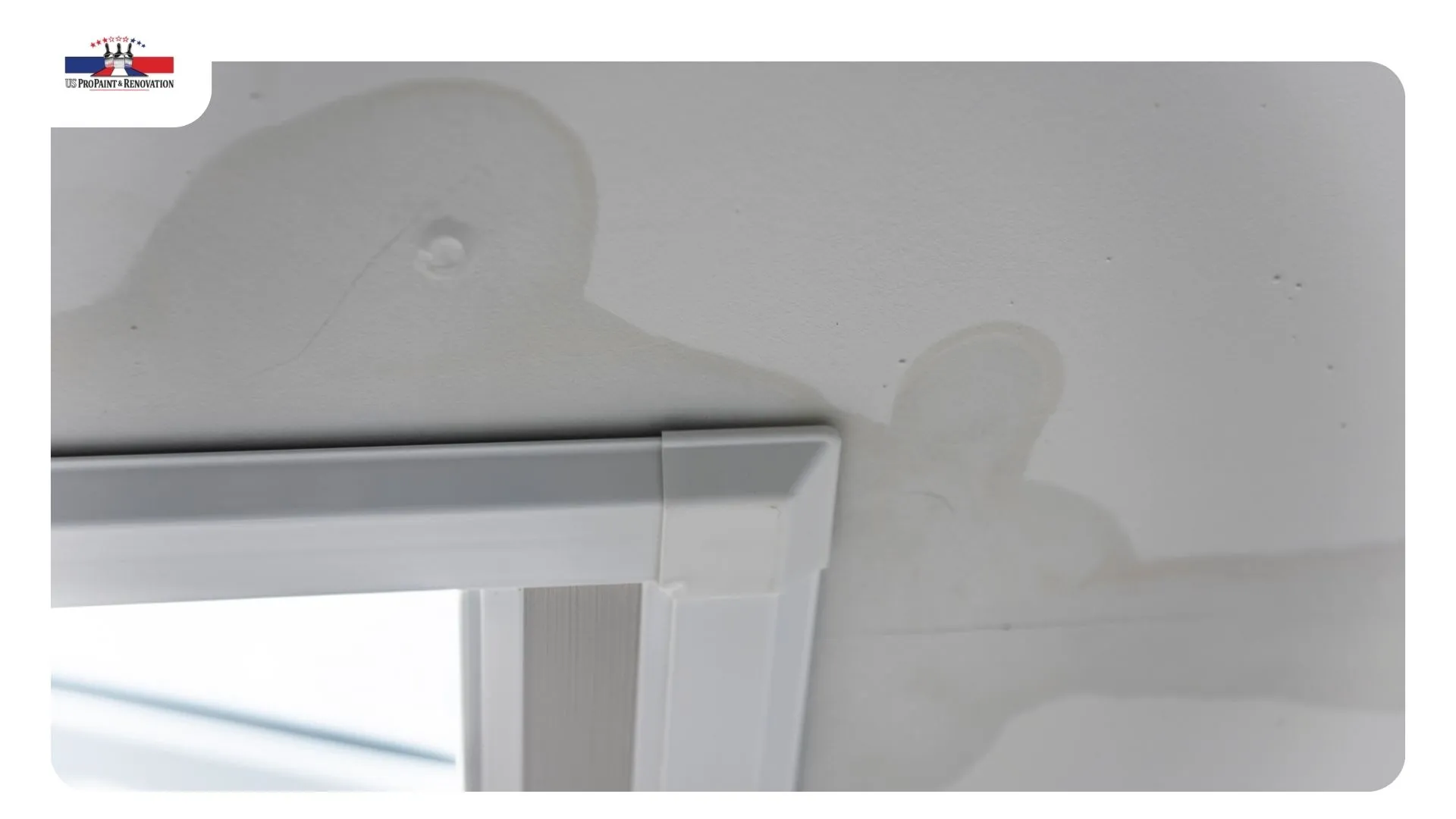
One thing to be clear about first. If water is actively running right now, this isn’t the page you need — shut off the supply and call a plumber or an emergency mitigation company with extraction and drying equipment. We don’t do emergency extraction. What we do is everything after: assessing what the water damaged, cutting out and replacing what can’t be saved, matching the texture, and repainting so the repair disappears. Most homeowners call us two days to two weeks after the leak, which is exactly the right time.
The obvious brown ceiling ring isn’t the problem — everyone sees that one. These are the ones that get ignored for months:
1. A stain with a hard, darker edge. That ring is a tide line. A crisp, well-defined edge usually means the area has dried; a soft, feathered edge often means it’s still active. Either way it tells you water sat there.
2. Paint that bubbles, blisters or sags. Moisture behind the paint film pushes it off the substrate. On a ceiling this is more urgent than it looks, because saturated drywall gets heavy.
3. Drywall that gives under light pressure. Press gently with a fingertip. Sound drywall is firm. Compromised drywall feels spongy or slightly soft, and it won’t recover once it’s dried.
4. A musty smell with no visible source. Your nose finds mold before your eyes do. A persistent musty odour in one room, one closet or one corner of a basement almost always means moisture in a cavity.
5. Nail pops and seam cracks that appear in a line. Drywall that has been wet and dried swells and shrinks, pushing fasteners out. A row of new nail pops across a ceiling is a moisture signature, not a settling issue.
6. Trim, baseboard or window casing separating from the wall. Wood swells when wet and doesn’t return to shape. Gaps that weren’t there last year are worth investigating.
7. A water bill that climbed for no reason. The leak you can’t see is often the one inside a wall. An unexplained jump is worth a plumber’s diagnostic before it becomes a drywall problem.
Braintree’s housing stock runs heavily to mid-century capes, colonials and split-levels, with denser older housing around Braintree Highlands and East Braintree. On homes of this age and type, water tends to arrive from the same places:
The bathroom directly above. The single most common source of a ceiling stain on a first floor. A failed wax ring at the toilet, a shower pan or surround leaking through grout, or a supply line weeping behind the vanity. The stain is usually offset from the fixture, because water runs along a joist before it drops — which is why the repair often reveals a wetted area larger than the stain suggested. If the bathroom above is due for work anyway, doing the bathroom renovation and the ceiling repair together makes far more sense than sequencing them.
Ice dams. The New England specialty. Snow melts on a warm roof deck, refreezes at the cold eave, and the resulting dam pushes water backwards under the shingles and into the wall or ceiling below. Damage shows up on exterior walls and on ceilings near the perimeter, usually in February and March. If that’s your pattern, the real fix is up on the roof and in the attic insulation, not in the drywall.
Failed supply lines and water heaters. Braided washing machine hoses, dishwasher lines, and water heaters at the end of their life. These fail suddenly and do a lot of damage fast.
Basement moisture and foundation seepage. Slower and easier to normalise. People live with a damp corner for years. It still counts.
Window and door flashing. Water entering around a window head shows up as staining below the sill or as bubbling paint on the wall beneath, and it’s often mistaken for condensation.
The important part: fix the source before the finish. We won’t close a ceiling over an active leak. If the cause isn’t identified yet, that’s the first conversation, and sometimes it means a plumber or a roofer before us.
EPA guidance is that wet materials should be dried within 24 to 48 hours to prevent mold growth, with hidden areas — behind walls, above ceilings, in crawl spaces and attics — needing the same attention as visible ones. Past that window the question changes from “can this be patched” to “what’s growing in the cavity.” The EPA is careful to note that mold won’t always appear after 48 hours; it’s a guideline, not a certainty. But it’s the right line to plan around.
This is where we differ from most drywall-and-paint contractors answering these searches. US ProPaint holds a Certified Residential Mold Inspector licence (CRMI0000036883) and a Certified Mold Remediator licence (CMR0000036885). If we open a ceiling and find mold, we can assess it and remediate it rather than stopping the job while you find someone who can — or worse, closing the ceiling back up over it.
Ask any contractor quoting your ceiling what they do if they find mold behind it. The answer tells you a lot.
Sometimes sealing and repainting is genuinely the right answer. It depends on three things:
Is it dry? Not “does it look dry” — actually dry, with the source fixed. Painting over damp drywall traps moisture and the stain returns within months.
Is the drywall structurally sound? Press it. If it’s firm with no sag, no crumbling and no soft spots, the substrate is fine and you’re dealing with a cosmetic stain.
How long was it wet? A ceiling that got wet once and dried within a day or two is a different case from one that’s been quietly wet for a season.
If all three check out, the repair is straightforward: a stain-blocking primer — shellac or oil-based, because a water-based primer will let tannin and rust stains bleed straight back through — then texture matching and paint. Skipping the right primer is the most common reason a “repaired” ceiling stain reappears.
Replacement is the answer when the drywall is soft or sagging, when there’s any visible mold, when the wet area kept growing, when insulation above was saturated, or when the ceiling has been wet more than once. In those cases we cut back to sound material, check the cavity and the insulation, replace, and refinish.
On texture: we match it. Knockdown, orange peel, skip trowel, smooth — and on older Braintree homes, occasionally plaster rather than drywall, which needs a different approach entirely. Because we run our own interior painting and carpentry crews, texture matching and repainting are part of the same job rather than a second contractor and a second wait. A repair that’s structurally perfect but visibly patched isn’t finished.

| Scope | Typical 2026 range (eastern MA) |
|---|---|
| Cosmetic only — stain blocked, primed, repainted | $250 – $600 |
| Small ceiling patch with texture match and paint | $400 – $900 |
| Ceiling section cut out, insulation checked, replaced and refinished | $900 – $2,500 |
| Large area or multiple rooms, framing involved | $2,500 – $8,000+ |
| Add: mold remediation | $10 – $20 per sq ft |
These are market ranges, not our quotes. Drywall labour in Massachusetts metros runs roughly $80–$110 per hour — among the highest in the country — and ceiling work costs meaningfully more than the same repair on a wall, because overhead work is slower, compound sags against gravity, and insulation usually has to come out and be inspected. Small repairs also carry a minimum call-out, so one patch costs far more per square foot than four patches done in the same visit. If you have several, get them done together.
On insurance. Homeowners policies in Massachusetts generally cover sudden and accidental water damage — a burst pipe, a failed water heater — but typically exclude gradual leaks and flooding, which needs separate flood coverage. That distinction is your insurer’s call, not ours, and we don’t act as public adjusters or negotiate claims. What we do provide is documentation: photographs of the damage before we touch anything, and a written itemised scope of the repair. Most homeowners find that’s what their adjuster asks for. Take your own photos too, before any repair work starts, and don’t dispose of damaged material until you’ve checked with your insurer.
We’re at 175 Derby Street in Hingham, about fifteen minutes from most of Braintree:
How much does water damage repair cost in Braintree?
A cosmetic repair — stain blocked, primed and repainted — runs roughly $250 to $600. A ceiling patch with texture matching runs $400 to $900. Cutting out and replacing a ceiling section with insulation checked runs $900 to $2,500, and larger or multi-room damage runs $2,500 and up. Mold remediation, if needed, adds roughly $10 to $20 per square foot.
Do you repair and repaint water damaged ceilings and walls?
Yes, both. We cut out and replace compromised drywall, check the cavity and insulation, match the existing texture, and repaint with our own crew. We handle repair and restoration after the water has been stopped — we don’t provide emergency extraction or structural drying.
Can a stained ceiling be sealed and repainted, or does it need replacing?
It can be sealed and repainted if the area is fully dry, the source is fixed, and the drywall is still firm with no sag, crumbling or visible mold. It needs replacing if the drywall is soft or sagging, mold is present, insulation above was saturated, or it has been wet more than once. Sealing requires a shellac or oil-based stain-blocking primer — a water-based primer lets the stain bleed back through.
Do you match existing texture and finish when repairing?
Yes. We match knockdown, orange peel, skip trowel and smooth finishes, and we work with plaster as well as drywall on older homes. Texture matching and repainting are done by our own crews as part of the same job, so there’s no second contractor and no second wait.
Do you work with homeowners insurance claims for the repair?
We document the damage with photographs before work begins and provide a written itemised scope, which is typically what an adjuster asks for. We aren’t public adjusters and we don’t negotiate claims on your behalf — the claim stays between you and your insurer. Take your own photos before any repair starts, and check with your insurer before disposing of damaged material.
US ProPaint and Renovation
Adress:175 Derby St STE 4 Hingham, MA 02043
Office: (617) 922-6305 · Toll free: (800) 964-0717
Massachusetts Contractor License 186517 ·
Mold Inspector CRMI0000036883 · Mold Remediator CMR0000036885 Serving Braintree and the South Shore, including East Braintree, South Braintree, Braintree Highlands, Weymouth, Quincy, Milton, and Hingham.