
A handyman handles the small, unglamorous jobs that never quite justify a contractor — sticking doors, drywall patches, trim repair, caulking, fixture swaps. In Massachusetts there’s a specific point where that stops being legal, and it’s lower than most homeowners expect. US ProPaint & Renovation takes small repair work across Weymouth and the South Shore, charged hourly with a minimum.
By JR Reis, Owner & President · Last updated October 2026
The common ones, roughly in order of how often we’re asked:
Doors and windows — doors that stick or won’t latch, hinge screws pulled out of the jamb, thresholds needing adjustment, worn weatherstripping and door sweeps. Most draught complaints are one of these rather than a new door, and we’ve written about why that is.
Walls and ceilings — drywall patching, nail pops, hairline plaster cracks, anchor holes from old fixtures, small water-stain touch-ups once the leak itself is dealt with.
Trim and carpentry — damaged baseboard and casing, loose handrails, a rotted trim board, shelving, closet systems, a sagging cabinet door.
Caulking and sealing — around tubs and showers, at exterior trim joints, around windows. Unglamorous, cheap, and one of the highest-return maintenance items there is.
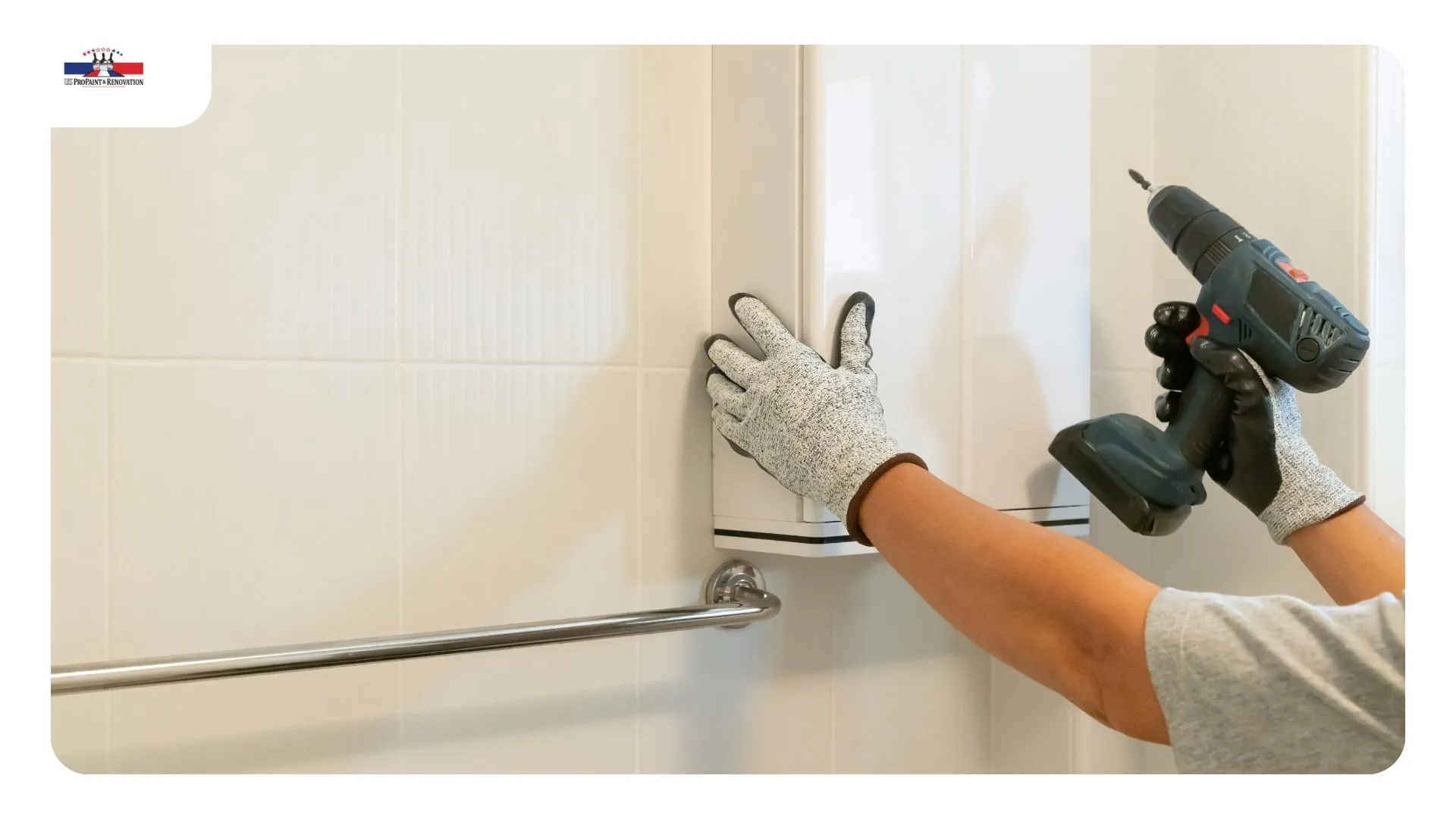
Mounting and fitting — TVs, mirrors, heavy artwork, grab bars, curtain hardware, blinds.
Seasonal and exterior — gutter cleaning, weatherstripping before winter, deck board replacement, railing repair, small fence fixes.
Fixture swaps — a like-for-like faucet, toilet or vanity top. With a caveat in the next section that matters more than anything else on this page.

Most handymen in this area charge by the hour with a minimum, rather than by the job. We do the same:
Why minimums exist is worth understanding, because it’s the thing that frustrates people about small jobs. A fifteen-minute repair still involves loading a van, driving to Weymouth, parking, setting up, protecting the floor, doing the work, cleaning up and driving back. The billable fifteen minutes sits inside about two hours of actual cost. A minimum is how that gets covered honestly rather than by padding the hours.
It’s also exactly why batching jobs is the right move — more on that below.
Larger, better-defined work gets quoted as a fixed price instead. If the job has a clear scope and a known end point, hourly billing stops being the fair way to price it for either side.
This is the part almost nobody knows, and it protects you.
Massachusetts doesn’t issue a handyman licence. There’s no handyman exam and no handyman registry. What exists instead is a two-credential framework that quietly defines where handyman work ends.
Over $1,000 — combined labour and materials — on an owner-occupied one-to-four family home, the person doing the work must be registered as a Home Improvement Contractor under M.G.L. c.142A. That registration brings real consumer protections with it: a written contract, a three-day right of cancellation, a cap on the deposit, and access to the state Guaranty Fund if something goes badly wrong.
Below that threshold, no state registration is required.
Three things this means in practice:
Electrical, plumbing and gas work are different again. Those require the relevant trade licence regardless of job size. There is no dollar figure below which an unlicensed person may legally run a circuit or re-pipe a drain. A like-for-like fixture swap is one thing; anything touching the wiring or the piping behind it is licensed work, full stop.
And permit-required or structural work needs a Construction Supervisor Licence, which is a separate, exam-based credential from the HIC registration.
We hold Massachusetts Home Improvement Contractor registration #186517 and are lead-safe certified.
Seven triggers. Any one of them means you want a registered contractor rather than a general handyman:
The honest version: what turns a handyman job into a contractor job is usually discovery, not the original request. A soft spot under a window isn’t a trim repair — it’s a flashing failure that’s been running for two winters, and we’ve written about how to find where that water is actually getting in. A section of siding that needs replacing may be a repair, a repaint, or a replacement, and you can’t tell from the street.
That’s the practical advantage of having a renovation contractor do your small jobs: when something opens up and turns out to be real, you don’t start again with a different phone number.
Yes, and it’s much the most economical way to use us.
Because minimums and travel dominate the cost of any single small job, five jobs in one visit cost dramatically less than five separate call-outs. One van, one trip, one setup.
How to make it work: walk the house with a notepad over a week and write everything down — the door that sticks, the two drywall patches, the loose handrail, the caulking around the tub, the light fitting nobody’s got to. Send the list. We’ll price the visit as a whole and tell you honestly if anything on it belongs in a different category.
Two natural moments to batch:
Where we work: Weymouth, Hingham, Braintree, Quincy, Hull, Cohasset and Scituate.
Building on the South Shore since 2004, Massachusetts HIC registration #186517, lead-safe certified, fully insured. Our carpentry, interior painting and water damage pages cover the larger scopes small jobs sometimes turn into.
What kinds of jobs does a handyman actually handle?
Sticking doors and failed weatherstripping, drywall and plaster patching, trim and baseboard repair, caulking around tubs and exterior joints, mounting TVs and grab bars, shelving, gutter cleaning, deck board and railing repair, and like-for-like fixture swaps. Anything requiring a permit, anything structural, and any electrical, plumbing or gas work beyond a straight swap falls outside it.
Is a handyman charged hourly or by the job?
Usually hourly with a minimum, which is how we charge small repair work. Travel, loading and setup dominate the cost of any one short job, so a minimum covers that honestly rather than inflating the hours. Larger jobs with a clearly defined scope are quoted as a fixed price instead.
When is a job too big for a handyman?
When it needs a permit, when it’s structural, when it involves electrical, plumbing or gas beyond a like-for-like swap, when it exceeds $1,000 in combined labour and materials, when it disturbs painted surfaces in a pre-1978 home, or when there’s water damage, rot or mould behind it. Above $1,000 Massachusetts requires Home Improvement Contractor registration, and without it you have no Guaranty Fund protection.
Is there a minimum call-out charge?
Yes — we work hourly with a minimum. A fifteen-minute repair still involves loading, travel, setup, protection and cleanup, and the minimum covers that rather than being recovered through padded hours. Batching several jobs into one visit is the way around it.
Can several small jobs be done in one visit?
Yes, and it’s considerably cheaper than booking them separately, because one visit means one mobilisation rather than five. Keep a running list, send it over, and we’ll price the visit as a whole — and flag anything on it that belongs in a different category.
Does a handyman need a licence in Massachusetts?
There’s no handyman licence in Massachusetts. But any home improvement work over $1,000 in combined labour and materials on an owner-occupied one-to-four family home requires Home Improvement Contractor registration, with a written contract and a three-day right of cancellation. Electrical, plumbing and gas work requires the relevant trade licence at any job size, and permit-required or structural work requires a Construction Supervisor Licence.
How much does a handyman charge?
Most charge hourly with a minimum rather than by the job. Our rate is with a [INSERT MINIMUM] minimum. The economics of small jobs are dominated by travel and setup rather than the work itself, which is why batching several repairs into one visit costs far less than booking them individually.
US ProPaint & Renovation
Adress:175 Derby St STE 4 Hingham, MA 02043
Phone: +1 (617) 922-6305
Toll Free: +1 (800) 964-0717
Email: office@uspropaint.com
Massachusetts Home Improvement Contractor registration #186517 ·
Lead-Safe Certified