
Sometimes — and it’s worth asking, because framing is the cheap part of a deck and boards are the expensive part. But three things decide it, and joist spacing rules out more Braintree frames than rot does. US ProPaint & Renovation replaces decks across Braintree, and this is the check we run before quoting either way.
By JR Reis, Owner & President · Last updated November 2026
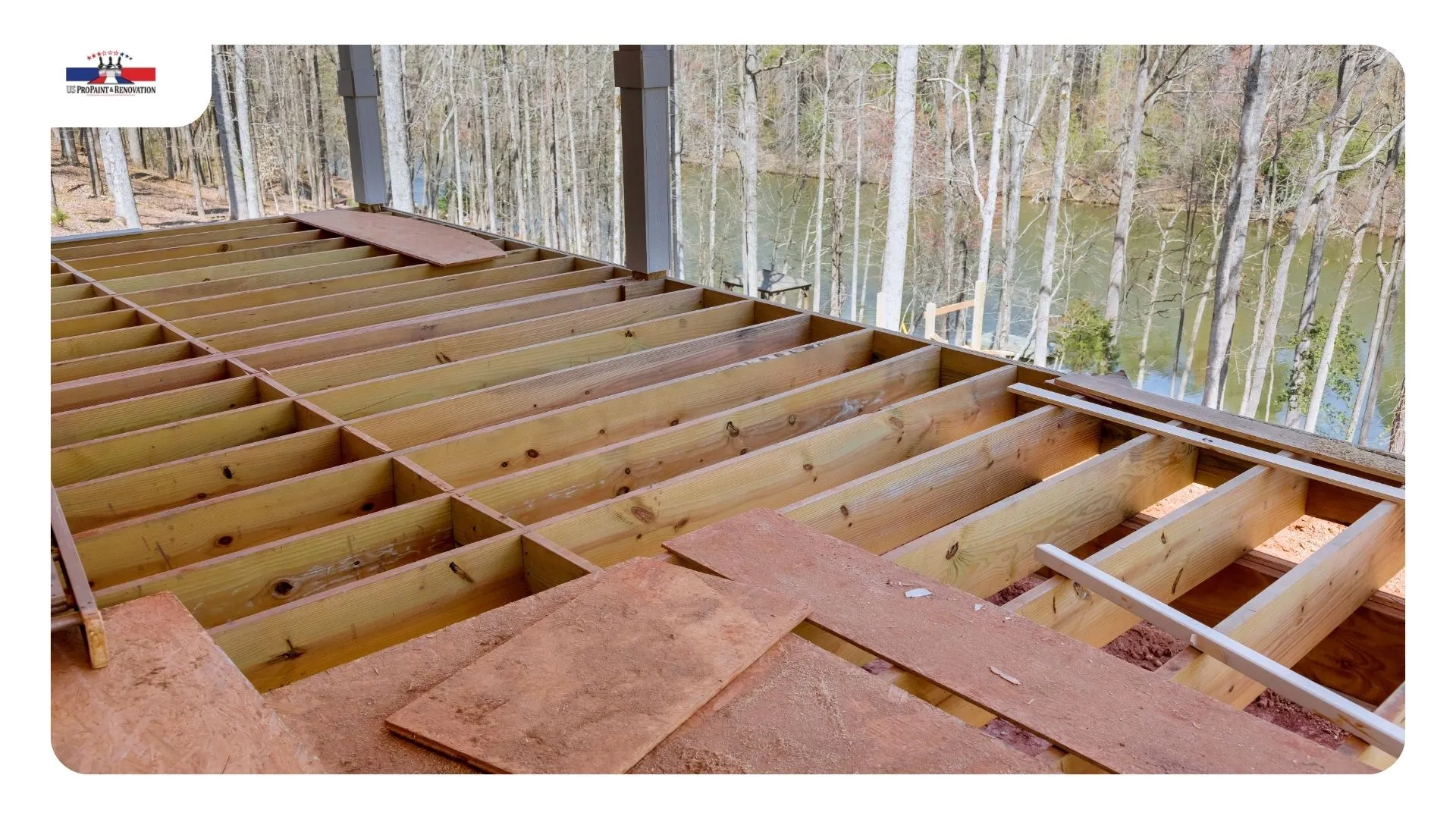
Is the frame actually sound? Joists, beams, posts and ledger all have to be free of rot and decay. One soft joist can be sistered. Several, or a post rotted at grade, and you’re building a new deck around a problem you’ll meet again.
Does the joist spacing match your new decking? This is the one that catches people, and it has nothing to do with the frame’s condition. More on it below.
Do the footings and ledger meet current code? A frame built in 1995 was built to 1995’s rules. Massachusetts wants footings bearing below frost — commonly 48 inches here — and lateral-load hold-down hardware at the house connection is a more recent requirement than most existing decks. If the ledger was nailed rather than bolted, or was never flashed, that connection is getting rebuilt no matter how good the joists look.
Composite isn’t just heavier than wood. It’s less rigid than a solid wood plank of the same thickness, so it deflects more between supports. Space the joists as widely as you would for wood and the finished deck feels spongy underfoot and develops permanent waves.
So composite comes with its own framing requirement:
| Decking layout | Maximum joist spacing |
|---|---|
| Perpendicular (90°) boards | 16 inches on centre |
| Diagonal (45°) boards | 12 inches on centre |
| Stair treads | Often 12 inches or closer |
Pressure-treated decking tolerates 16 inches comfortably and older decks were sometimes framed wider still — 24 inches on centre was common, which is too wide for nearly every composite product on the market.
The fix is real but it isn’t free: sistering a new joist between each existing one to bring spacing down. On a sound frame that’s worth doing. On a tired one you’ve just paid to reinforce something that was going to be replaced anyway.
One more thing worth knowing before you commit. Composite telegraphs a tired frame more than wood does. Old pressure-treated joists crown, twist and cup over twenty years. Wood decking has enough flex and enough visible grain to hide some of that. A flat, uniform composite surface shows every high joist as a visible ridge — and once the boards are down, the only fix is taking them back up.

Honest accounting: on a typical replacement, the framing is a minority of the job. Demolition, boards, railing, fasteners and finish work are where the money sits. Keeping a sound frame saves real money, but it doesn’t halve the project.
And here’s the trap. Composite decking is sold on a 25-year surface life. A pressure-treated frame in New England gets roughly 10 to 15 years of serviceable life with maintenance, and the frame underneath an older deck has usually had none, because nobody maintains what they can’t see.
Bolt a 25-year surface to a frame with five years left and you will take that surface off again — carefully, because composite boards don’t always survive removal — to replace what’s under it. That’s the single most expensive mistake in this category, and it’s why we’d rather spend an hour under your deck with a flashlight than quote from the driveway.
Rough guide: if the frame has meaningfully less life left than the surface you’re putting on it, tear off and rebuild. If it’s sound, correctly spaced and code-compliant at the footings and ledger, reuse it and spend the savings on better boards.
For the wider repair-versus-replace decision, our deck safety assessment post covers the warning signs, and when to replace a deck covers the thresholds.
Shorter than people fear, with one caveat.
Call it one to three weeks of active work, with the yard genuinely disrupted for the first few days of that. If footings are going in, expect spoil piles and limited access to that side of the house. We stage material to keep driveways usable and sweep for fasteners daily.
The caveat is the calendar, not the crew: concrete and winter don’t cooperate on the South Shore, so a November tear-off with new footings is a spring conversation.
We’re at 175 Derby Street in Hingham, about fifteen minutes from Braintree — East Braintree, Braintree Highlands, South Braintree and around South Shore Plaza — plus Weymouth, Quincy, Milton, Hingham and Randolph.
A Braintree homeowner had us remove an existing rear deck and replace it with a larger composite one. We recast new foundation piers rather than reusing the old ones — which is exactly the call this post is about, made in the other direction, because the existing footings weren’t worth building a twenty-five-year deck on.
Full scope sits on our deck repair and replacement page, and material choice is covered in our composite versus pressure-treated guide. When you’re ready, book a free on-site assessment — we’ll get under the deck and tell you which way the numbers point.
Is it cheaper to repair or fully replace my deck?
Repair, when the frame is sound and the damage is isolated. Once repairs approach roughly half the cost of a new deck — multiple soft joists, rotted post bases, heaved footings — replacement is better value, because you get current code, current hardware and a fresh start on lifespan.
How much does deck replacement cost in Braintree, MA?
New deck construction generally runs $25 to $65 per square foot, composite at the upper end and pressure-treated at the lower, plus demolition and disposal of the old deck. Reusing a sound frame reduces that, though framing is a smaller share of the total than most people expect.
Can the new deck reuse the existing footings and frame?
Only if three things hold: the framing is free of rot, the joist spacing meets your new decking’s requirement — 16 inches on centre for perpendicular composite, 12 for diagonal — and the footings and ledger meet current code. Older frames at 24 inches on centre need joists sistered in before composite can go down.
How long will my yard be a worksite during a deck replacement?
One to three weeks of active work, with the heaviest disruption in the first few days during tear-off and any footing excavation. Inspection holds between stages add calendar time rather than work time.
What warranty comes with a replacement deck?
Ask any contractor for two separate things in writing: the decking manufacturer’s warranty on the boards, and the contractor’s own workmanship warranty on the build. They cover different failures and they expire at different times. We’ll put both in your written estimate before work starts.
US ProPaint & Renovation
Adress:175 Derby St STE 4 Hingham, MA 02043
Phone: (617) 922-6305
Toll Free: (800) 964-0717
Email: office@uspropaint.com
Serving Scituate and the South Shore, including Scituate Harbour, North Scituate, Minot, Sand Hills, Humarock, Cohasset, Marshfield, Hingham, Weymouth, Braintree and Quincy.