
Composite wins on maintenance, pressure-treated wins on upfront cost — but the honest answer is that the decision matters less than most homeowners think. Under almost every composite deck in Braintree sits a pressure-treated wood frame, and the frame is what fails first in Massachusetts.
By JR Reis, Owner & President · Last updated November 2026
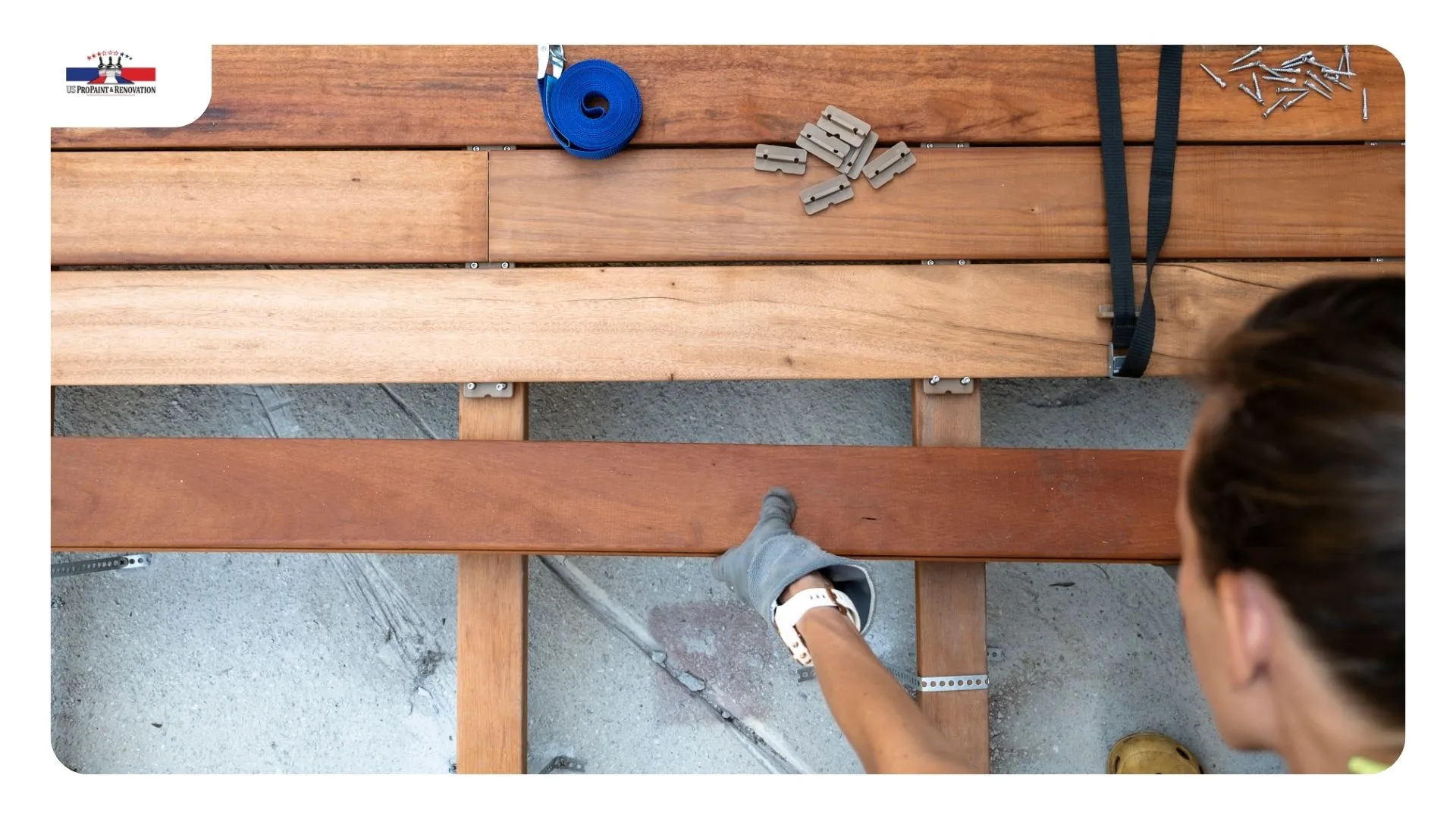
This is the thing the brochures skip. Composite is a surface product. The posts, beams, joists, ledger and stair stringers holding it up are pressure-treated lumber on the overwhelming majority of residential decks, including ours.
Which means the twenty-five-year warranty you’re buying covers the part that was never going to rot. The parts that actually determine whether your deck is sound in year fifteen — footings below frost, ledger attachment, hardware, flashing — are identical whichever surface you pick.
So pick the surface on lifestyle and budget. Then ask hard questions about the frame, because that’s where the money either went or didn’t.
| Pressure-treated | Composite | |
|---|---|---|
| Upfront cost | Lowest | Noticeably higher |
| Maintenance | Clean and re-seal every 2–3 years | Wash occasionally |
| Realistic surface life | 10–15 years with upkeep | 25+ years |
| In full sun | Stays cooler underfoot | Gets genuinely hot, especially dark colours |
| In shade and damp | Can grey and mildew; sealing helps | Mould can grow on the surface film; capped boards resist it far better |
| Movement | Checks, splits, cups, pops fasteners | Dimensionally stable |
| If you skip maintenance | Degrades quickly | Mostly fine |
Two New England-specific notes that don’t show up in national comparisons.
Shade matters more here than heat does. A lot of Braintree back yards are tucked behind mature trees, and a damp, shaded deck is where composite’s weak point shows — surface mould on the board film, which people wrongly assume means the board is rotting. Capped composite handles this far better than early-generation uncapped product. If your deck gets little sun and lots of leaf litter, specify capped and plan on a wash each spring.
Pressure-treated isn’t the cheap option it used to be, and it isn’t a bad one. A properly built PT deck that gets cleaned and sealed on schedule will serve a long time. The question is honest self-assessment: if you know you won’t re-seal it every two or three years, you’re buying a ten-year deck, and composite is the cheaper choice over twenty.
Massachusetts runs on 780 CMR, now in its 10th Edition — based on the 2021 IRC and the sole code in force since July 2025. Decks are not a grey area in it.
You need a permit if the deck is attached to the house — any size, any height — or sits more than 30 inches above grade, or exceeds roughly 200 square feet. A rebuild counts: if you’re replacing footings, framing and ledger rather than just swapping surface boards, that’s a permitted job. And if a contractor is doing the work, a licensed Construction Supervisor’s name and licence number go on the application.
What gets inspected, in order:
Footings, before the pour. Eastern Massachusetts has one of the deepest frost requirements in the country. The frost line runs around 40 inches here and building departments want the footing bottom at 48 inches below grade, on undisturbed soil, with diameter sized to the post load. An inspector will check the hole before concrete goes in — pour first and you may be digging it out again.
The ledger, at framing. This is the one that matters most: ledger failure is the single most common cause of deck collapse. The connection has to be lag screws or through-bolts in a staggered pattern, hot-dip galvanised or stainless, with proper flashing behind the ledger so water can’t sit against the house rim joist. Nails do not attach a deck to a house. Alongside it the inspector checks joist hanger gauge and nailing, beam-to-post connections, post bases, and lateral load hold-down connectors under IRC R507.9.2 — the hardware that stops the deck pulling away from the house under load.
Guards and stairs, at final. Guard required once the walking surface is more than 30 inches above grade, 36 inches tall for a one- or two-family home, balusters spaced so a 4-inch sphere can’t pass through, plus handrail graspability on the stairs.
Two inspections minimum, then. A framing inspection before anything is closed in, and a final once railings and stairs are done.

Plan on four to eight weeks end to end for a standard attached deck.
The two things that stretch it: zoning relief if the deck encroaches a setback, and footings hitting ledge or water — both of which we’d rather find at the estimate than in week three.
We handle the permit application and schedule the inspections as part of the project.
We’re based at 175 Derby Street in Hingham, about fifteen minutes from most of Braintree — East Braintree, Braintree Highlands, South Braintree and the streets around South Shore Plaza. From there it’s Weymouth, Quincy, Milton, Hingham and Randolph.
A Braintree homeowner had us tear out an existing rear deck and replace it with a larger composite one. The part of that job he singled out afterwards wasn’t the decking — it was that we recast new foundation piers rather than reusing the old ones, and that the finished structure felt solid. That’s the whole argument of this post in one review: the surface is what you see, the substructure is what you’re buying.
Full scope and pricing detail sits on our Braintree deck construction page and the statewide deck service page. When you’re ready, book a free on-site estimate — we measure, check the grade and setbacks, and price it properly. Financing is available on larger projects.
How much does deck construction cost in Braintree, MA?
New deck construction typically runs $25 to $65 per square foot, with composite at the upper end and pressure-treated at the lower. Height, stair count, railing style, footing conditions and whether an old deck has to come out all move the number. Our deck cost and hiring guide breaks it down.
Do I need a building permit for a new deck in Braintree?
Almost certainly. Under 780 CMR a permit is required for any deck attached to the house regardless of size, any deck more than 30 inches above grade, and generally anything over about 200 square feet. Rebuilding an existing deck’s structure counts too. We file the application and schedule inspections for you.
Composite or pressure-treated: which holds up better in Massachusetts weather?
Composite holds its surface longer — 25-plus years against 10 to 15 for well-maintained pressure-treated — and shrugs off freeze-thaw without checking or splitting. Pressure-treated costs less upfront and stays cooler in full sun. In shaded, damp yards, specify capped composite rather than uncapped.
How long does a new deck take from permit to final inspection?
Four to eight weeks for a standard attached deck: one to two weeks of design, one to three weeks for drawings and permit, one to three weeks of construction with inspection holds after footings and at framing, then the final once railings and stairs are in.
Do you give free on-site estimates in Braintree, MA?
Yes — free, on site, with no obligation. We walk the yard, check grade, setbacks and access, and talk through materials before anything is priced. Financing is available on larger deck and renovation projects.
US ProPaint & Renovation
Adress:175 Derby St STE 4 Hingham, MA 02043
Phone: (617) 922-6305
Toll Free: (800) 964-0717
Email: office@uspropaint.com
Serving Scituate and the South Shore, including Scituate Harbour, North Scituate, Minot, Sand Hills, Humarock, Cohasset, Marshfield, Hingham, Weymouth, Braintree and Quincy.