
Most Massachusetts painting contractors will tell you May through October, and that holds up. The stronger answer is the back half of that window. Late August through early October brings drier air, daytime highs in the 60s and 70s, and crews that have cleared the spring backlog. Within that stretch, dew point decides whether a given day is paintable. The calendar only narrows the window. US ProPaint & Renovation has painted South Shore homes since 2004.
By JR Reis, Owner & President · Last updated October 2026
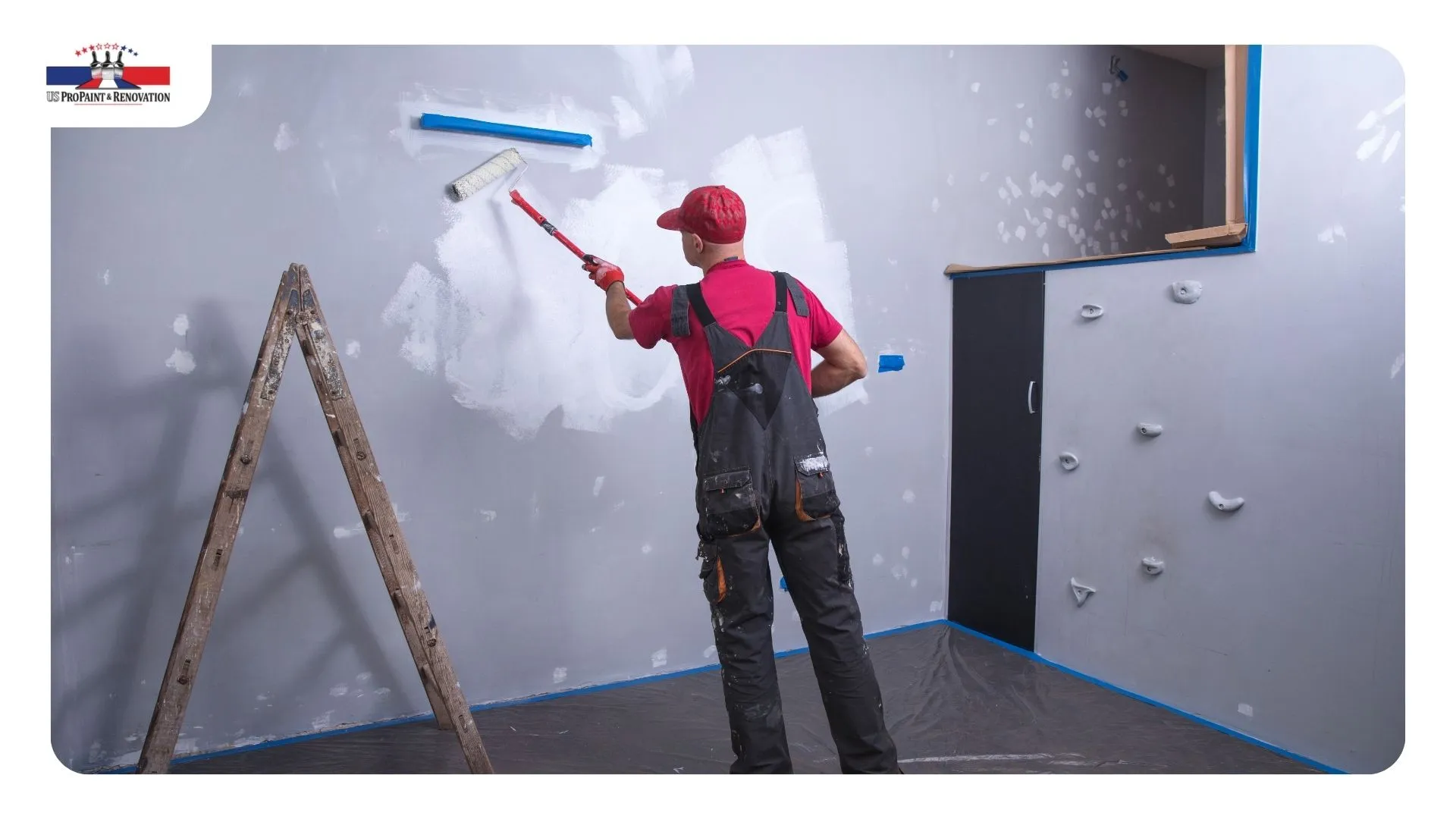
The dew point rule is the one most homeowners never hear. Manufacturers require the air and the surface to be at least 5°F above the dew point when paint is applied. Below that, moisture condenses onto the wall as you’re coating it — the same thing that puts dew on a windshield. On a cool, humid New England morning, that can make a 45°F day unsuitable even though the thermometer looks fine.
The other limits:
| Month | Exterior conditions |
|---|---|
| Jan – Feb | Too cold. Interiors and cabinets — and the best time of year to book an exterior |
| March | Interiors, plus exterior carpentry and rot repair on dry days |
| April | Shoulder. Workable days, but variable, and pollen needs washing off first |
| May – June | Prime season. Also peak demand |
| July – Aug | Good, with heat management — above 90°F latex flashes off too fast, so crews follow the shade |
| Late Aug – mid Oct | The best conditions of the year. Lower humidity, moderate temperatures, cleared backlogs |
| Late Oct – Nov | Low-temperature products only. Doable, with a narrowing margin each week |
| December | Interiors. Best availability of the year for indoor work |
We paint exteriors May through October and run interiors through the winter. We do use low-temperature product lines to extend the shoulder, but honestly: every week past mid-October narrows the margin for error, and a job that has to bond before an overnight drop is a job with less room in it. We’ll tell you when waiting until spring is the better call.
Two scheduling points worth acting on. By April, every competent crew in this market is booking into July — so book a spring exterior in January or February. And if your house needs carpentry or rot repair before paint, get that done in March. A paint crew waiting on a carpenter in May is how a spring project becomes an August one.
Three to seven days for an average South Shore home, and one to three weeks for a larger house or one needing significant prep.
The sequence, and why most of it isn’t painting:
Prep is 60 to 80% of the labour on an exterior, which is why a quote that’s dramatically cheaper than the others hasn’t found efficiencies — it has removed steps you can’t see from the driveway.
Weather is the honest variable. A forecast change can push a project several days, and a contractor who promises an exact finish date in New England is promising something they don’t control.
Four to seven years on coastal South Shore wood clapboard, against seven to ten inland. Budget paint fails in three to four regardless of where the house sits.
Most coastal paint advice online comes from Florida, California, or the Gulf — and those coasts face salt plus heat. The South Shore faces salt plus freeze-thaw, and New England has among the highest freeze-thaw cycle frequency in the country. That combination is harder on a paint film than either stress alone:
That’s why a product spec’d for a Carolina beach house doesn’t automatically suit Scituate or Hull.
Which elevations go first: south and west faces take the UV, and water-facing elevations take the salt. On an exposed South Shore home those are often the same wall.
How often to repaint: plan on the whole house when the worst elevation is due, rather than doing faces piecemeal. By the time the south or seaward face visibly needs it, the sheltered faces are usually within a year or two of due anyway — and one mobilisation, one staging setup, and one crew costs considerably less than two.
One thing that genuinely extends paint life here: rinse the salt off. An annual fresh-water wash of water-facing elevations removes the salt film that’s holding moisture against the coating. It’s the cheapest maintenance available on a coastal house.
Signs it’s time: chalking that comes off on your hand, fading on the sun-facing walls, hairline cracking in the film, and caulk that has pulled away at joints and trim.

Short version, because our guide to choosing a painting contractor covers the full vetting framework and what painters actually charge.
What should be itemised in writing, not summarised as “prep as needed”: washing, scraping, sanding, any carpentry or rot repair, spot-priming, full-priming where bare substrate is exposed, caulking, the number of finish coats, and the products by name.
The coastal addition: the wall has to be rinsed of salt film before anything else happens. A coat applied over salt won’t make two seasons, and no amount of premium paint compensates for it.
And if the siding itself is the question rather than the finish — whether boards need repair or replacement before any paint goes on — that decision is covered in our siding repair, repaint or replace guide.
The same evening, usually — but “dry” and “cured” are different things, and that difference is where damage happens.
| Stage | Typical timing |
|---|---|
| Dry to touch | About 1 hour |
| Ready to recoat | About 4 hours |
| Light use of the room | 24 hours |
| Fully cured | 2 to 4 weeks |
Until latex fully cures, the film stays soft enough to mark, imprint, and lift. So for the first couple of weeks:
Low-VOC products reduce the smell considerably but do not cure faster — that’s a common and expensive misunderstanding.
For what interior work costs room by room and what to expect while living through it, see the interior painting guide.
Where we work: Hingham, Scituate, Cohasset, Weymouth, Hull, Quincy, Braintree, and across the South Shore.
Service details are on our exterior painting and interior painting pages. Finished work is in the gallery.
When is the best season to paint a house exterior in Massachusetts?
Late May through early October, with late August into early October the single best stretch — lower humidity, moderate temperatures, and cleared backlogs. The deciding factor on any given day is the dew point: air and surface temperature both need to be at least 5°F above it, which can rule out a cool humid morning even when the air temperature looks acceptable.
How often do coastal South Shore homes need repainting?
Every four to seven years on wood clapboard, against seven to ten inland. Budget paint fails in three to four anywhere. Repaint the whole house when the worst elevation is due rather than doing faces piecemeal — the sheltered walls are usually within a year or two of due anyway, and one mobilisation costs far less than two.
What prep work should a painting contractor include in the quote?
Washing, scraping, sanding, carpentry and rot repair, spot-priming, full-priming where bare substrate is exposed, caulking, the number of finish coats, and the products named. “Prep as needed” commits to nothing. On a coastal house, add a salt rinse before anything else — a coat over salt film won’t last two seasons.
How long does exterior paint last this close to salt air?
Four to seven years on coastal wood siding. Salt is hygroscopic, so it holds moisture against the paint film and keeps the wall damp longer than an inland wall stays; that trapped moisture then goes through dozens of freeze-thaw cycles each winter, working at adhesion from underneath. New England’s combination of salt and freeze-thaw is harder on paint than the salt-plus-heat of southern coasts.
How soon can rooms be used after interior painting?
Light use after 24 hours, but full cure takes two to four weeks. Until then the film stays soft enough to mark — so avoid pushing furniture against walls, taping anything to the surface, or washing the walls for about 30 days. Low-VOC paints smell less but don’t cure any faster.
How long does exterior painting take?
Three to seven days for an average South Shore home, or one to three weeks for a larger house or one needing significant prep. Washing takes a day and drying one to two more, because a house washed in the morning isn’t ready that afternoon. Prep is 60 to 80% of the labour.
Can you paint a house exterior in winter in Massachusetts?
Not reliably. Most exterior paints need surface and air temperatures steadily above 50°F, and the 35°F minimum some products carry requires temperatures to stay above that for 48 hours after application — which Massachusetts winters rarely deliver. We paint exteriors May through October and schedule interior work for the winter months.
US ProPaint & Renovation
Adress:175 Derby St STE 4 Hingham, MA 02043
Phone: +1 (617) 922-6305
Toll Free: +1 (800) 964-0717
Email: office@uspropaint.com
Massachusetts Contractor
License 186517 · Lead-Safe Certified
Serving Hingham, Scituate, Cohasset, Weymouth, Hull, Norwell, Braintree, Quincy and the South Shore.