
A full siding replacement means stripping the house to its sheathing, fixing what’s underneath, rebuilding the water barrier, then installing new siding and trim. US ProPaint and Renovation runs these from our Hingham shop across the South Shore. Most homes take one to two weeks of active work.
By JR Reis, Owner & President · Last updated September 2026
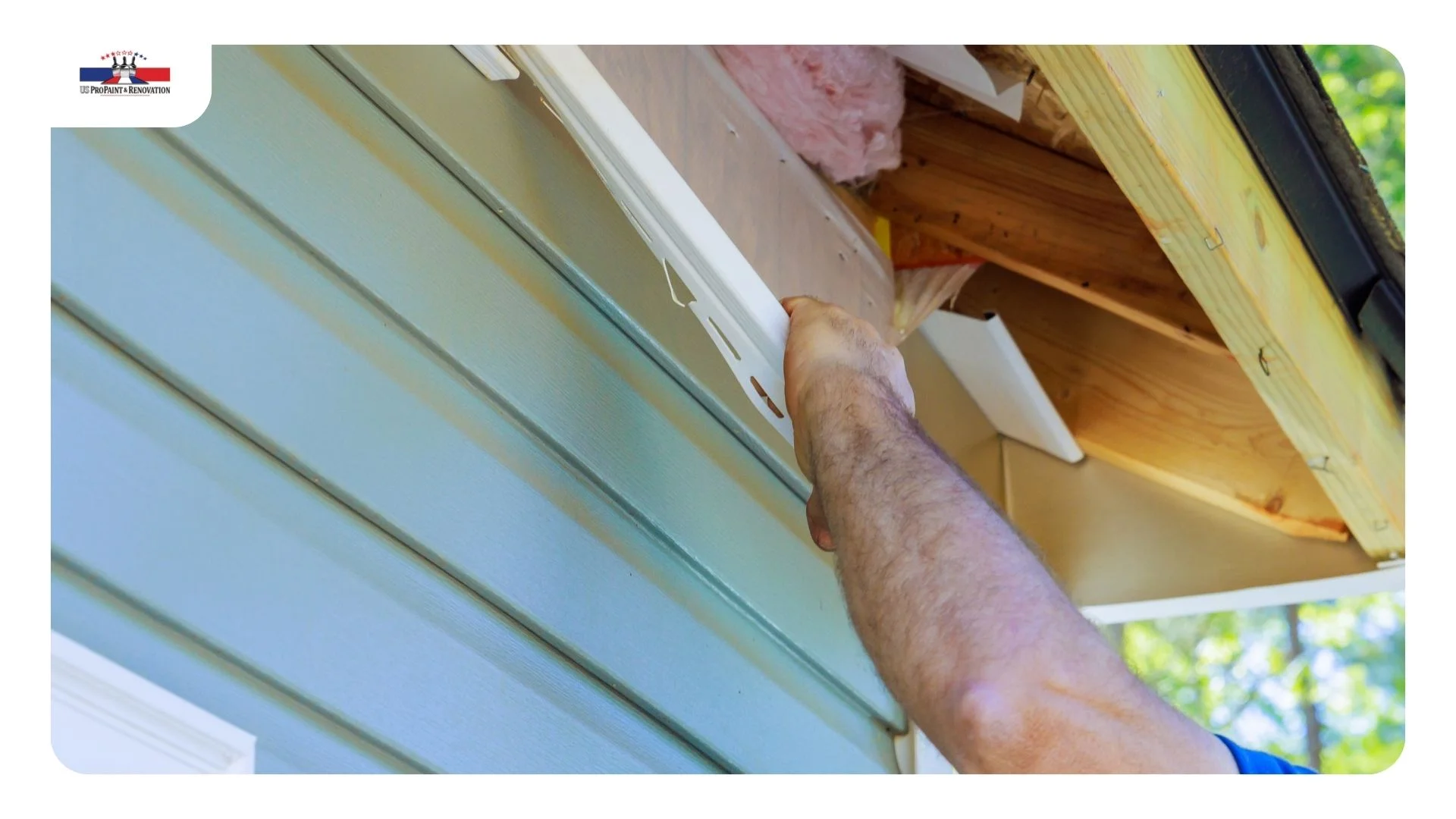
Most homeowners booking a re-side have only seen the finished version — a truck shows up, a week later the house looks new. The part that determines whether the job lasts thirty years or fails in eight happens in the two days after the old siding comes off, when nobody is taking photos. Here’s the whole sequence.
1. Measurement and written estimate. We measure wall area by elevation, not house square footage, and note every penetration, transition and detail that adds labour. You get a written scope. Free, and we’ll tell you if what you actually need is a repair rather than a replacement.
2. Permit. Every South Shore town we work in requires a building permit for siding. Weymouth lists it explicitly alongside roofing and windows on its building permit page, and the process is similar in Hingham, Braintree and Quincy. We pull it.
3. Tear-off and disposal. Old siding comes off, usually one elevation at a time so the house is never fully exposed. This is also when we find out what we’re really dealing with.
4. Sheathing and structural repair. Anything soft gets cut out and replaced. This is the stage that moves the budget, and it’s the one no contractor can quote accurately before tear-off — anyone who tells you otherwise is guessing.
5. Water-resistive barrier and flashing. Housewrap goes on, then flashing at every window head, door head, roof-wall junction and penetration. Kick-out flashing where a roof edge meets a wall is the single most commonly missed detail in older work, and it’s responsible for a large share of the rot we cut out.
6. Siding, trim and finish. New siding, corner boards, window and door trim, soffit and fascia as needed. On cedar and fiber cement we prime or finish as part of the install through our own exterior painting crew rather than subbing it out.
7. Cleanup and final walkthrough. Magnetic sweep for nails, debris hauled, and a walk of every elevation with you before we call it done.
On a repair you only open the damaged section. On a full replacement you see the whole envelope at once, and on South Shore homes built before the mid-1980s the same issues turn up repeatedly:
No water-resistive barrier at all. Plenty of older homes on the South Shore were sided directly over board sheathing with tar paper or nothing. The siding was the weather barrier. That works until one board fails.
Flashing that was never there. Window heads relying on caulk, roof-wall junctions with no kick-out, deck ledgers tucked behind siding with no flashing above them. Water follows the path of least resistance and it always finds these.
Rot concentrated in four places. Bottom courses where splash-back keeps the wood wet, corner boards, under leaking gutter seams, and on the north and east elevations that don’t get enough sun to dry after a nor’easter. Coastal exposure accelerates all of it — wind-driven rain off Hingham Bay and the Weymouth Fore River pushes water up behind laps in a way ordinary rainfall doesn’t, and salt air is hard on fasteners.
Old window units worth replacing while the walls are open. Re-siding around original single-pane units means paying twice if you replace them later. If new windows are on your list at all, this is the moment.
If we find moisture that made it past the sheathing into framing or insulation, we bring in our water damage crew rather than close the wall over it. That’s a conversation we’d rather have on day three than have you discover in year two.
This is the argument we make to every homeowner re-siding a house built before about 1980, and it’s the one most siding contractors skip because it isn’t their trade.
Adding exterior insulation or air sealing during a re-side costs a fraction of doing it as a standalone project, because the demolition and access — the expensive parts — are already paid for. Do it afterwards and you’re paying to remove siding you just bought.
Mass Save doesn’t rebate siding itself, but it covers a substantial share of qualifying insulation and air-sealing work, in some cases the full cost depending on income eligibility, and it starts with a no-cost home energy assessment through your utility. Booking that assessment before your re-side, not after, is the single highest-value thing you can do with the timing. Confirm current terms directly — the programme changes.
Worth knowing on older homes: Massachusetts runs its own lead programme under 454 CMR 22.00, and any contractor disturbing more than 20 square feet of exterior painted surface on a pre-1978 house must hold a Lead-Safe Renovation Contractor licence from the Department of Labor Standards. A full tear-off clears that threshold on the first wall. Ask to see it.

Fiber cement and quality cedar handle South Shore conditions best. Fiber cement doesn’t rot, doesn’t feed insects, holds paint for a long time and won’t warp in freeze-thaw cycles. Cedar performs well when it’s properly finished and maintained, and it’s often the right call on older homes where profile and character matter.
Vinyl is the value option and it’s genuinely improved — insulated vinyl adds continuous insulation across the wall and cuts thermal bridging. Its weaknesses in our climate are impact brittleness in deep cold and colour fade on south and west elevations over fifteen-plus years. Fine choice on a mid-century cape in Weymouth or a newer build; less convincing on an exposed coastal property.
Cedar shingle and clapboard suits the older housing stock in Hingham, Cohasset and Scituate, and it’s the only one of the three you can repair board-by-board indefinitely. It needs refinishing on a cycle — every five to eight years on exposed elevations near the water, longer inland.
Fiber cement is what we recommend most often for full replacements on coastal-exposed homes. We’re a James Hardie Contractor Alliance member, so we install it to spec: correct fastener spacing, proper clearance at grade and roof lines, factory-matched trim.
The honest version: on a sheltered inland lot in Braintree or Milton, all three will serve you well and the decision is budget and appearance. Within a half-mile of the water in Scituate or Marshfield, the gap between them widens considerably.
Timeline. One to two weeks of active work for most single-family homes, weather permitting. Add time for extensive sheathing repair, elaborate trim, or three-storey staging. We work one elevation at a time so the house isn’t open longer than necessary.
Cost. Full replacement on a typical South Shore single-family home runs roughly $12,000 to $28,000 for vinyl and $20,000 to $45,000+ for cedar or fiber cement, as of 2026. Eastern Massachusetts runs 15–30% above central and western parts of the state for identical scope. Those are market ranges, not our quotes — there’s a fuller breakdown by scope in our siding repair and cost guide, and the only number that means anything is the written one we give you after measuring your walls.
Paying for it. A re-side is one of the larger single exterior projects a homeowner takes on, so we offer financing — ask during your estimate. If insulation is part of the scope, Mass Save’s 0% HEAT Loan may cover that portion separately.
We’re at 175 Derby Street in Hingham, and most siding jobs sit within a thirty-minute drive:
Not listed? Ask anyway — we work across Norfolk, Plymouth, Middlesex and Barnstable counties.
How much does siding replacement cost in the Weymouth area? As of 2026, full replacement on a typical single-family home runs roughly $12,000 to $28,000 for vinyl and $20,000 to $45,000+ for cedar or fiber cement. Wall area, number of storeys, trim complexity and how much sheathing repair turns up after tear-off are the variables that move it.
Do you offer free siding replacement estimates? Yes. We measure your walls by elevation, walk the property with you, and give you a written scope and price at no cost.
What siding materials do you install? Vinyl and insulated vinyl, cedar clapboard and shingle, and fiber cement — we’re a James Hardie Contractor Alliance member. We also handle all the trim, soffit, fascia and carpentry that goes with a re-side, and finish it with our own painting crew.
Which siding holds up best to coastal salt air and New England winters? Fiber cement, for most coastal-exposed homes — it won’t rot, warp or feed insects, and it holds paint well through freeze-thaw cycles. Properly finished cedar performs well too and is the better fit where historic character matters. Vinyl is a sound value choice on sheltered inland lots.
Do you offer financing for a siding replacement? Yes. We offer financing on larger exterior projects — ask during your free estimate. If your project includes insulation, Mass Save’s 0% HEAT Loan may apply to that portion separately.
Tell us the house and we’ll measure it. Book a free estimate and we’ll walk every elevation with you and put a written scope in your hands.
US ProPaint and Renovation
Adress:175 Derby St STE 4 Hingham, MA 02043
Phone: (800) 964-0717 ·
Office: (617) 922-6305
Serving the South Shore and Norfolk County, including Hingham, Weymouth, Braintree, Quincy, Milton, Cohasset, Scituate, and Marshfield.